Sunday, June 25, 2017

What I collect

More than a year since my last blog post - sorry, folks!

So, maybe time for a different style of post - what do we collect and why?   In the last few years, I've collected mainly Roman Republican coins, but I have plenty of other collecting areas.

One long-term interest is in ancient Greek coins of the Classical era - the coins of the city states, which bear the emblems of their cities - the owls of Athens, mentioned in an earlier post, turtles of Aegina, Pegasus on the coins of Corinth and so on.   The numismatic art of some of the late fifth/early fourth century BC Sicilian coins remains unequalled and I have been lucky enough to pick up a few fairly worn specimens.

Other collecting interests are more transitory, but just as rewarding - here's one.

In the summer of 2007, I spent a few days in Girona, in Spain's Catalunya region and while driving one day spotted a sign "Ruinas".   It turned out to be the remains of the Greek (and later Roman) town of Emporion - Empúries.

It was an idyllic summer day by the sea -

Asclepius statue, Emporion

Emporion ruins by the sea

Floor mosaic, Emporion

Forum, Emporion

As a coin collector, the obvious question for me was "Did Emporion mint coins?".   Indeed it did - the Greek city was a major trading centre and minted drachms and fractions, which were later copied by other Iberian cities in the area.   The on-site museum had some modern reproductions on sale, but I wanted something original and it took me about 3 years to get what I wanted :)

In 2009, at the Real Casa de la Moneda shop in Madrid Airport (I don't think the mint has a shop there any more), I found this modern €10 coin, part of a series "Joyas Numismaticas" which reuses ancient and mediaeval Spanish coin designs on modern commemorative coins.

Modern Spanish €10 coin reproducing drachm of Emporion
This coin reproduces a drachm of Emporion with the head of Arethusa on the obverse with three dolphins around and Pegasus on the reverse.   In common with many of the ancient drachms of Emporion, the head of Pegasus is formed by Chrysaor - in Greek mythology Chrysaor was the brother of Pegasus.

This was a start, but I wanted some ancient coins.   I contacted a Spanish dealer and, by chance, on his desk he had half a drachm:

Cut drachm of Emporion

This was a drachm of Emporion from sometime before 250 BC, but was obviously cut in ancient times to circulate as a half drachm.   I got this in July 2009.

Emporion Hemitrietartermorion
Next, in October 2009, on eBay from the same seller I got this fraction - a tiny 0.15g 7.5mm hemitritetartermorion.   This is quite a scarce little coin.

Emporion drachms and their contemporary copies are fairly common in Spanish auctions and finally in December 2010 I got one:

Emporion Drachm
This was struck from fairly worn dies (especially the reverse) and the reverse is somewhat off-centre, so there's room for improvement.

Books on ancient coins are a close second in interest to the coins themselves - to properly catalogue these, I bought Alvarez-Burgos - "La Moneda Hispánica, desde sus orígenes hasta el siglo V" and, recently, a Forni reprint of Alois Heiss's 1870 work "Description générale des monnaies antiques de l'Espagne".

So - a chance encounter with some ruins and a very pleasant day wandering through them has resulted in the purchase of four coins and two books.   Maybe someday I'll get a stunning drachm, but for now the 2010 purchase is OK.

Sunday, March 20, 2016

More Later Republican Denarii

Quintus Pomponius Musa

As we saw in a previous blog post, exactly a year ago, on 20th March, 2015, moneyers of the later Republican period exercised considerable freedom in designing the coinage and changed the designs every year, using the post as an opportunity to publicise an ancestor or indeed whatever took their fancy.

The topic of this post is the series of coins issued by Quintus Pomponius Musa in 66BC (date according to Crawford, Harlan dates the issue to 65BC).

While some moneyers went on to achieve fame or infamy in later life, Q. Pomponius Musa is unknown aside from his coins.   The gens Pomponia was an ancient Roman family, claiming descent from Pompo, a son of Numa, Rome's second king.   In any case, our Q. Pomponius Musa seems have issued coins featuring the Muses because muse rhymes with Musa.

Nine Muses are featured, each engaged in the activity for which she was known in the ancient world, plus Hercules.   So far, I've managed to acquire four of the Muses, plus Hercules; so, my collection is half-complete :)

The obverse of the coins is generally said to feature Apollo, with a different symbol associated with the Muse on the reverse, but Harlan claims that it's not the head of Apollo but a generic Muse.   I'd tend to agree with this, as the head is quite feminine, even for Apollo.   The coin featuring Hercules does have the head of Apollo on the obverse.   Apollo is normally regarded as the leader of the Muses, but in Rome there was a temple with statues of the nine Muses in the temple of Hercules - the statues of the Muses were taken as booty from the Greek city of Ambracia following its surrender to the Romans after a siefe in 189 BC.   The consul Fulvius Nobilior took over 1000 statues from the city and paraded them through Rome in his triumph in 187 BC.   At the same time as dedicating the statues of the Muses, Nobilior seems to have moved a shrine to the Camenae, obscure Goddesses which had become associated with the Muses, to the temple of Hercules.   This shrine had originally been dedicated by Numa, claimed ancestor of the Pomponii.   Harlan speculates that our Pomponius was associating his family with an original shrine of the Muses.

I've mentioned Crawford and Harlan in this post; next time, I'll give a bibliography for Roman Republican coins which will give an idea of what to read for more information.

Muses and their attributes

  • Calliope - Lyric Poetry

  • Cleio - History

  • Melpomene - Tragedy

  • Erato - Erotic Poetry

  • Terpischore - Dance (Tortoise behind head)


  • Euterpe - Lyric Poetry (crossed flutes behind head)

  • Urania - Astronomy (star behind head)

  • Thalia - Comedy

  • Polymnia - Rhetoric (wreath behind head)

  • Hercules - Leader of the Muses


Saturday, May 30, 2015

Back to posting soon - honest!

I hadn't meant to stop posting suddenly - I had at least one or two more posts left on the Roman Republican coins, but I got distracted and drifted away from it.

Most of the photos have disappeared - I'll upload them again.

Anyway, I promise to resume posting either tomorrow or Monday, so watch this space!

Friday, March 20, 2015

Later Denarii

Later Denarii

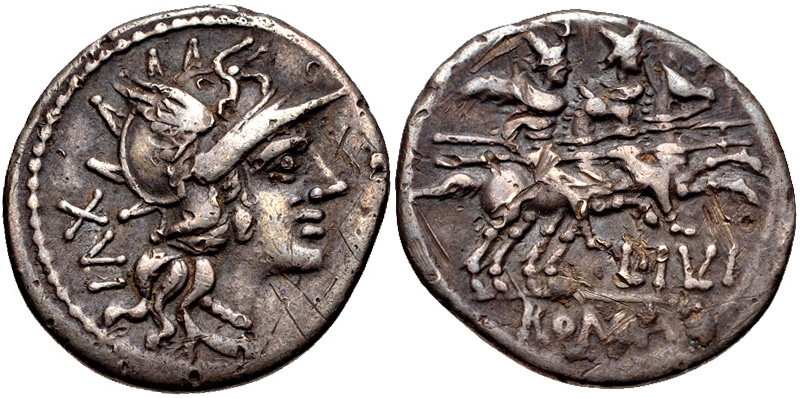
As we saw last time, the designs used on the main silver coins - denarii, quinarii & sestertii were all similar - helmeted head of Roma on the obverse and the Dioscuri on the reverse.   The early coins are all anonymous, not carrying the names of the moneyers.   Later, the moneyers started putting abbreviated versions of their names on the coins, like this example of Lucius Cupiennius from 147 BC.   At this stage, the design is the traditional Dioscuri.


On the reverse, the inscription reads L. CVP (VP written in ligature format), with ROMA in the exergue.   Note that in Latin, there is no distinction between U and V.

The other design commonly featured at this time has Victory in a biga on the reverse:

The example above is from Pinarius Natta, of 149 BC.   The moneyer's name is written as NATTA, with the second T and the final A superimposed.

At around the same time, in 141 BC, the denarius was retariffed to 16 asses, from 10.   Initially, the mark of value, X, was changed to XVI from X, as shown here on this denarius from 141 BC.


This particular coin is from Lucius Julius.   The XVI mark didn't last long in use - it was largely replaced by an X with a horizontal bar through it - believed to be a monogram of XVI.   In fact, on later issues, the X is often used again.

While the earlier coins with moneyers' names are of conventional types with names added, later types have designs apparently chosen by the moneyers themselves.   These often referred to heroic or imaginary deeds by their ancestors, as well as to current events.   Some examples...


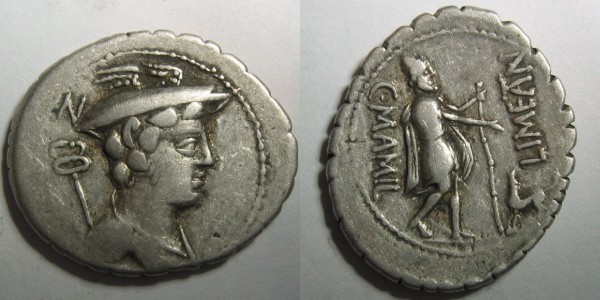
This coin is by Caius Mamilius Limetanus and dates from 82 BC.   The obverse features Mercury with a caduceus (staff).   The reverse has Ulysses returning from the Trojan War after 20 years, meeting his faithful dog Argos, who is the only one to recognise him in disguise.   The moneyer claimed to be descended from Ulysses and through him, from Mercury.


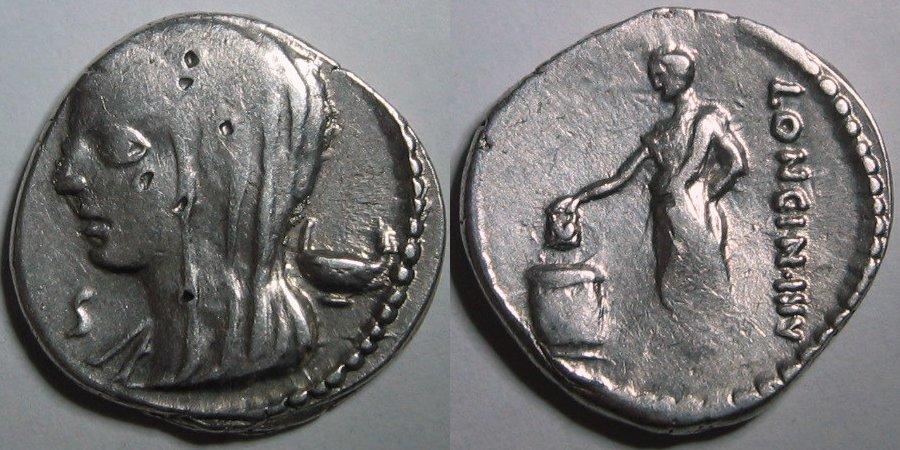
This type from 63 BC and features Vesta on the obverse and a voting scene on the reverse.   The voter is dropping a tablet inscribed V (for "Vti rogas") into a cista.   This is believed to refer to an ancestor of the moneyer, Lucius Cassius Longinus Ravilla, who presided over a commission of investigation of misdeeds by Vestal Virgins in 113 BC (three were executed).   The moneyer himself, another Lucius Cassius Longinus, was the brother of Caius Cassius Longinus, a conspirator in the assassination of Julius Caesar.

It's now late at night here, so more coins will have to wait for the next posting.

Friday, March 13, 2015

Denarius Coinage of 211 BC

Denarius Coinage

The Second Punic War ended with Roman victory, which came at a huge cost, financial was well as human.   During the war, the silver didrachms (quadrigati) were reduced in purity and size and the cast bronze coins (aes grave) reduced in size.


In 211 BC (the exact date of the introduction of the denarius was debated in the past, but most now accept 211 BC), a major reform of the coinage was enacted.   The debased quadrigati were replaced by a 10-as coin called the Denarius; there was a 5-as coin, the Quinarius and a 2.5-as coin, the Sestertius.   Additionally, there was another silver denomination, the Victoriatus (the name of this coin isn't known from antiquity, its modern name derives from its featuring Victory with a trophy on the reverse).   For the bronze coins, the as was now a struck coin of about 50g, with fractions - semis, triens, quadrans, sextans, uncia as before.   For a short time, gold coins were struck, in 20-, 40- and 60-as denominations.

Here's an early denarius


And a quinarius:


 And a sestertius:


There's a uniform design across the three main silver denominations - Roma in helmet on the obverse and the Dioscuri (Castor and Pollux) riding on the reverse.   Marks of value are on the obverse - X for ten asses, V for five and II S for 2.5 asses (two asses plus one semis).   The denarius initially weighed about 4.5g, the quinarius 2.2g and the sestertius 1.1g.

The bronze coins of the period had standard designs too - the prow of a galley on the reverse, with different obverse types and value marks, depending on the denomination:
  • Janus - as - I
  • Saturn - semis - S
  • Minerva - triens - four pellets
  • Hercules - quadrans - three pellets
  • Mercury - sextans - two pellets
  • Roma - uncia - one pellet
Examples of these coins are below:

The as - this is a relatively early example, well-worn.   There is a I over the Janiform heads and a dolphin symbol on the reverse, to the right of the galley:


A semis - S to the left of Saturn and over the galley on the reverse


A triens - four pellets above Minerva and under the galley:


A quadrans - three pellets behind Hercules and below the galley:


 A sextans - two pellets above Mercury and two under the galley.   There is also a letter L between the pellets on the reverse.   This signifies the mint where the coin was minted - Luceria:


And finally, the uncia - a single pellet behind Roma and under the galley.   I may be cheating here - this uncia probably pre-dates the denarius coinage :)


For nearly 20 years there were no innovations in the coin designs - the designs were fixed apart from symbols which were sometimes used - for example, the denarius above has a staff under the horses and the as has the dolphin.

In 194 BC, a change to the reverse was made - the Dioscuri were replaced by Luna driving a biga (chariot pulled by two horses) and later Victory driving a biga was tried.   Shortly after, the moneyers for each year started to put abbreviated versions of their names on the coins and then to change the designs each year.   The organisation of the Roman mint was such that three officials were appointed to oversee it each year, for a one-year term.   It wasn't a very high-ranking post - some moneyers went on to greater things, while others are known only from their coins.

Tune in next time for some of the more exciting later denarius issues :D


Tuesday, March 10, 2015

Roman Republican Coins

Roman Republican Coins

Yesterday's entry finished with the first silver coin struck for Rome, a didrachm (two drachma piece).
These coins were probably struck around 280 BC to pay for Rome's war against Tarentum and Pyrrhus, king of Epirus in Greece who came to the aid of the Greek colonies in Italy and is best remembered today for the term "Pyrrhic Victory".

As well as the Mars/horsehead didrachm, other types were struck with Apollo and Hercules on the obverse and a horse or wolf & twins on the reverse.


This is one of the slightly later types, with Apollo and a horse.   The legend is now ROMA, not ROMANO - it's now the name of the city, not "of the Romans", which was a more Greek-style legend.


Beneath is a struck bronze coin of the period (~300 BC to ~230 BC):


These were token coins (i.e. they circulated for a value in excess of their metal value) and probably were mainly used for trade with southern Italian cities, which wouldn't have used the much heavier cast bronze coins.

At around 225 BC, a design change took place, with the obverse now featuring a Janus head and the reverse Jupiter driving a quadriga (chariot drawn by four horses).   This change in design took place at the same time as a change to the designs of the cast bronze coins (aes grave).   These now featured a Janus head on the obverse of the as (the 1 pound coin) and the prow of a galley on the reverse.   Smaller bronze coins had different heads, but the prow reverse was standard.


This is an example of a later didrachm, the so-called quadrigatus - named for the quadriga on the reverse.   These initially weighed more than 6g and were of fine silver, but during the Second Punic War became lighter and made from debased silver as the Roman coffers ran low.   During this period, the coin was probably worth 6 asses (plural of as).

Drachm coins are less common - these are half the weight and have Jupiter driving left rather than right.

I don't have an example of an aes grave as, but here's a sextans (1/6th of an as):


Mercury is on the obverse (as on all sextantes) - he always is shown with the same winged hat which aids in identification.   There are two pellets below the head and two on the reverse, below the prow of a galley.

The Roman pound was made up of 12 unciae (ounces).   The number of pellets on the coins indicates how many unciae it weighs - a sextans has two pellets and is worth two unciae.   The standard denominations for these case coins were:

  • As - initially ~324g, later reduced to ~278g
  • Semis (half an as)
  • Triens (third of an as)
  • Quadrans (quarter of an as)
  • Sextans (sixth of an as)
  • Uncia (twelfth of an as)
Fractions of an uncia were also made - these were often struck - in fact, some of the smaller denominations were struck rather than cast.

From about 225 BC until after the Second Punic War, these were the coins issued by Rome - silver quadrigati and large cast bronze coins.

The main event in Roman Republican coinage history is the introduction of the Denarius Coinage in 211 BC and that will be the subject of the next post.

Monday, March 09, 2015

Ancient Coins

Ancient Coins

The last two posts were of Athenian tetradrachms - a classical issue and a later New Style issue.   I was about to post a coin of Rome today, but thought I should step back and give an overview of ancient coins in general and then move onto ancient Roman coins, instead of merely posting random coins which look nice.

Coinage began in Asia Minor (modern day Turkey) by the end of the 7th century BC.   The first coins were of electrum, an alloy of gold and silver.   Croesus, king of Lydia, is believed to have been the first to mint gold and silver coins, starting a bi-metallic scheme.   Initially, the coins were all minted in precious metals; later, token bronze coins were also minted.   Coinage spread throughout the Mediterranean region and many of the greatest works of numismatic art come from Sicily around the end of the 5th century BC.   At least three phases in the development of Greek coinage are normally distinguished - Archaic, Classical, Hellenistic - which echo developments in Greek Art.

In general, by around 400 BC, the Greek world had a silver drachma of about 4g, multiples - didrachms, tetradrachms, decadrachms and others, and fractions.   There were 6 obols in a drachms and tiny obol fractions - e.g. a tetartemorion was 1/4 of an obol - it weighed around 0.17g.   There were different weight standards in different cities, so some money-changing was required when travelling.

Ancient Roman Coinage

The situation in Rome and central Italy was somewhat different.   Instead of coins which we would recognise today, bars of bronze were used.   These were cast rather than struck and heavy - it seems that an early Roman currency bar, the Aes Signatum, was cast to a weight of 5 Roman pounds - about 1.6kg.   These were issued from around 320 BC to around 255 BC.   From around 300 BC, these bars were supplemented by round cast coins - initially to a 1 pound (Roman pound = 324g) standard, with fractions.   It was after 300 BC when Rome's first struck coins (as opposed to cast) appeared - didrachms and token bronze coins - these actually were stuck in southern Italy, probably Neapolis (Naples), rather than Rome.   One early bronze issue actually has a Greek legend.

The first Roman silver coin is shown below:


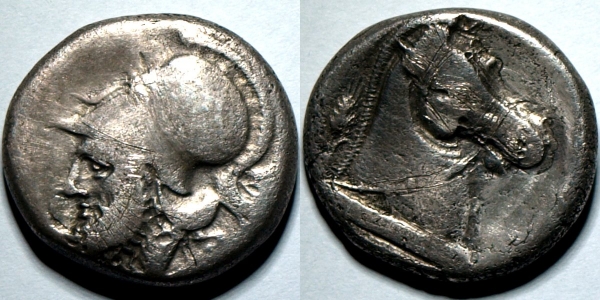
This was struck, probably in Neapolis or Metapontum, in around 280-276 BC.   It features Mars on the obverse and a horsehead on the reverse.   The legend has worn off on this example, but it reads ROMANO - short for ROMANORVM (of the Romans).   It's basically a copy of a typical southern Italy silver coin of the period.   This is a slightly earlier (ca 350-330 BC) coin from Metapontum:


The obverse is very similar and even the corn ear on the reverse appears behind the horse.   Horseheads are popular on the Carthaginian coins of the period from Sicily - e.g. see Siculo-Punic tetradrachm.

So, by 280 BC Rome had the beginnings of a Greek-style coinage minted in southern Italy along with parallel issues in Rome of large cast coins and bars.

To be continued :)


Friday, March 06, 2015

Another Athenian Tetradrachm

Well, one good tetradrachm deserves another.


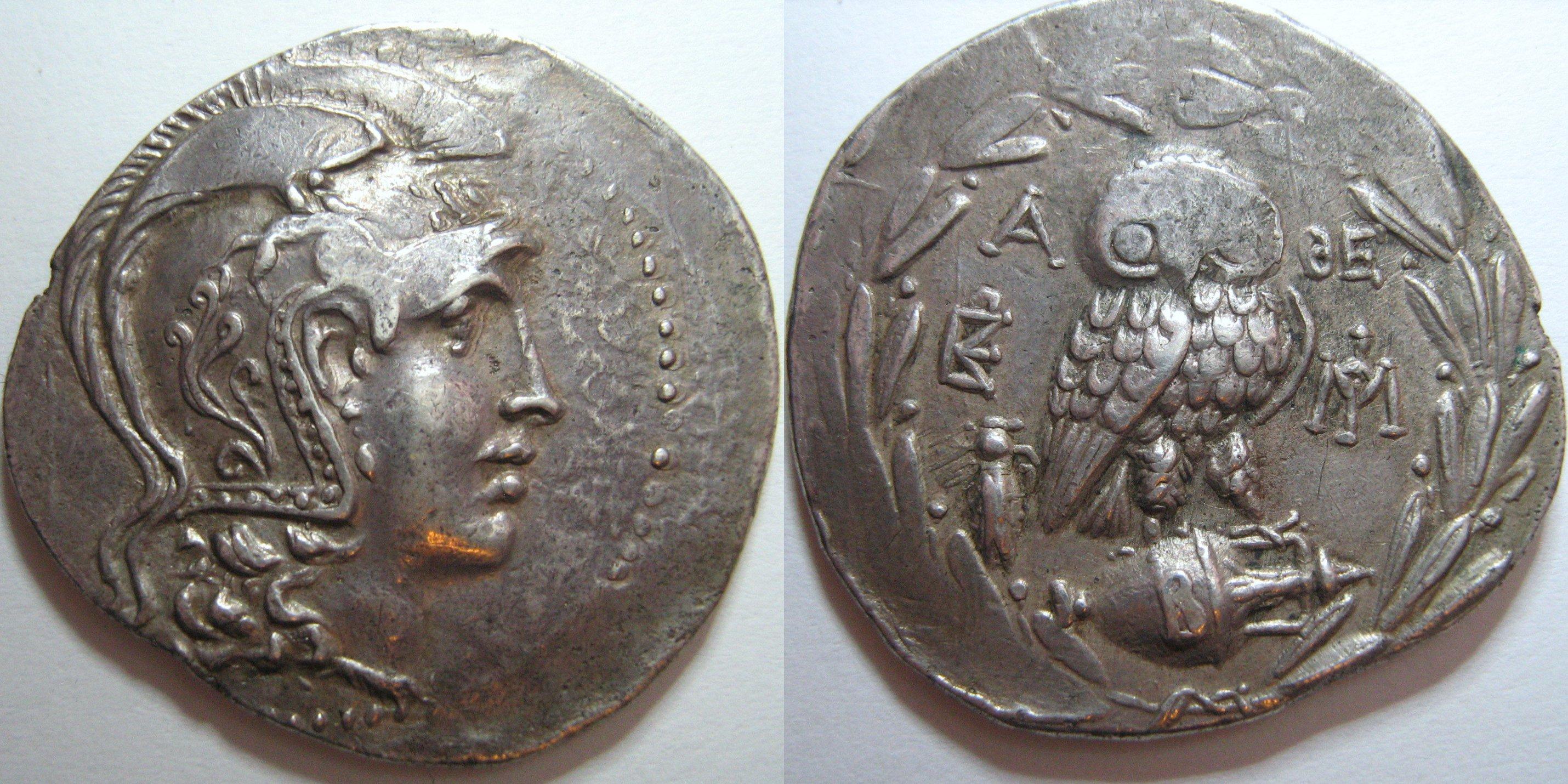
This is a "New Style" Athenian tetradrachm, dating from 153-152 BC.   It's got the same basic design as before - Athena on the obverse and an owl on the reverse, but the style of Athena is more realistic and the flan is much larger - this coin is approx. 32mm in diameter.   The weight is still around 17g, so the coin is much thinner than the earlier one.

The owl stands on an amphora which bears the letter B - this may refer to the month of issue.


Wednesday, March 04, 2015

Ancient Coins

My last post, 5 years ago, was about my blogging about coins on Google Buzz.   That service has since closed down, so I'll start here.

Where better to start with ancient coins than a classical Owl of Athens?


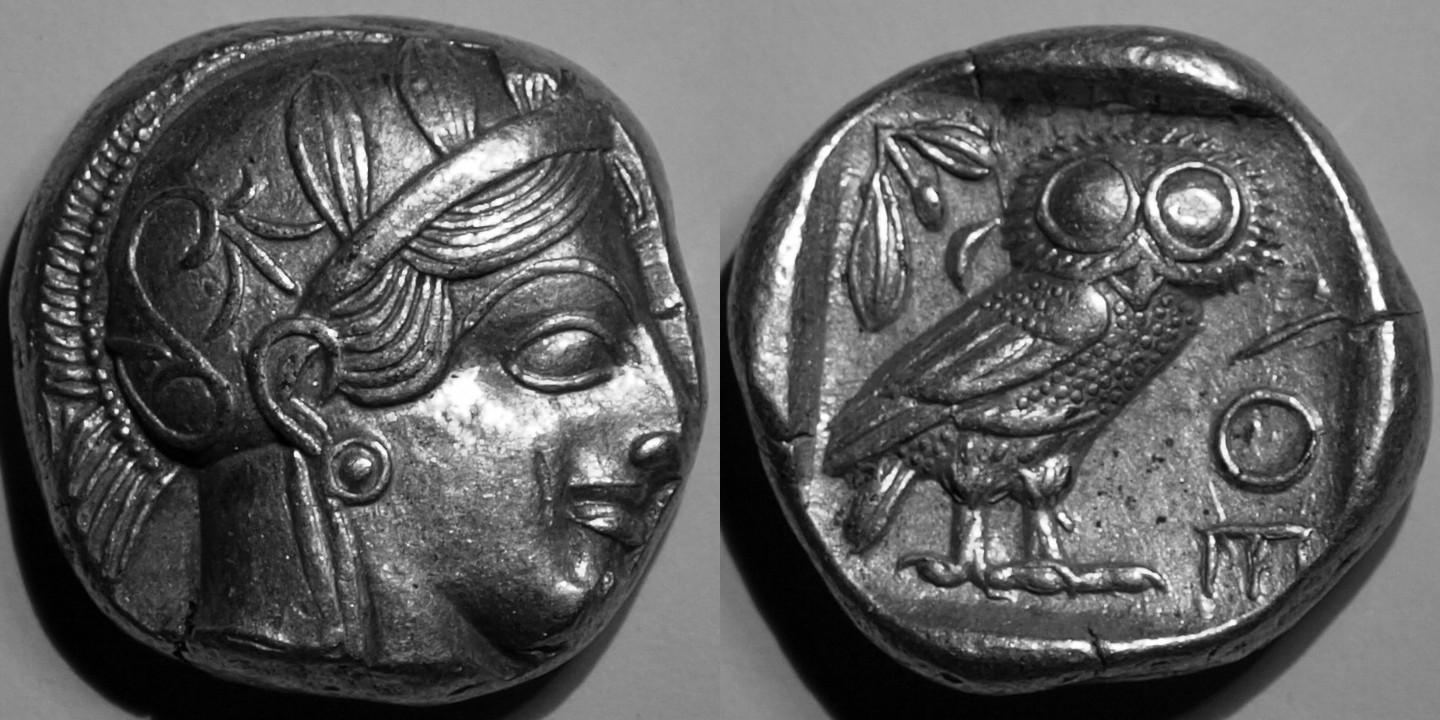
This is a tetradrachm (4 drachmae) of about 17g (this particular coin weighs 17.18g and is 23mm in diameter).

This coin was minted in Athens between 454 and 404 BC.   The obverse features Athena, the reverse, the owl, mascot of Athena, an olive sprig and a crescent moon.   It's thought that the moon refers to the Battle of Marathon - the great Athenian victory over the Persians in 490 BC.   Tetradrachms minted before the battle didn't feature the crescent.   The battle began during this phase of the moon - the Athenians requested reinforcements from Sparta but the Spartans delayed for the full moon and arrived after the Athenian victory.   The olive sprig probably refers to Athena's gift of the olive tree to Athens.

Tetradrachms like this were minted in large quantities over centuries, with design changes along the way, and circulated far and wide in the ancient world as a trusted means of exchange.   They remain common today.

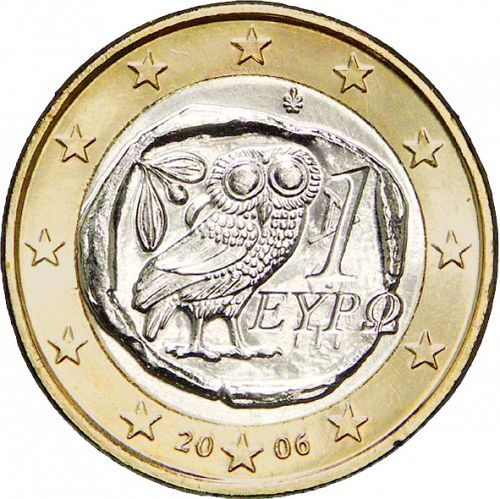
In today's Europe, the international currency is the Euro and it's appropriate that the current 1 Euro coins of Greece use as their reverse the owl.


The introduction of the Euro marked the end of 2500 years of the drachma; at least the design has survived :)

Wednesday, June 16, 2004

First posting

16th June, status of blog: empty until now.
Status of author: hungry, requiring nourishment, going for lunch.